You’re Not Doing It Wrong, You’re Missing a Simple System for Your Dog
A Simple Place to Start
There was a point where I genuinely questioned my life choices after getting a puppy. Not in a dramatic way, more so standing in my apartment, holding a leash, watching my dog spin around like a bucking bronco with a chip on his shoulder for authority. He wasn’t a bad dog. He was just “happy” or “excited”, everyone would say as he bounced around the elevator while I tried to get him to sit. I was not happy or excited about their advice, unsolicited nonetheless.
Other people would tell me he would grow out of it. Meanwhile I’m standing there thinking, okay, but when? I haven’t sat down in three weeks, my hands and feet are full of tiny cuts, and he just stole a sock for the umpteenth time. I soon learned I had the “puppy blues”. No one really talks about that part—the part where your dog is “normal” and “just a puppy”, but your left feeling miserable, your one more shrill little bark away from tears, and like this whole thing was a mistake.
It’s not always the big issues that people struggle with. It’s the small, constant things that wear on you over time. The jumping when you’ve fought tirelessly to end it, the pacing and getting into things when you’re trying to relax, the feeling that you can’t just stop “watching” your dog. Eventually, you start wondering if you’re doing something wrong, why it’s not clicking, and how everyone else seems to have this figured out. So you go online, like we all do, and it’s like getting on Web MD when you don’t feel good, suddenly you’re dying next Tuesday and your dog needs a Professional Whisperer.

The Answer is Not More, It’s Simple
Finding help for dog training feels like looking at Vogue when you were 13. When you see all these well behaved dogs following commands, pivoting on a dime you suddenly take that as a personal attack that you have never done a single thing correctly in your entire life. Just remember you are seeing their best moments, and it’s easy to make dog training look like an action movie online with the right sound track. You’re seeing the retakes, the edited version, the version they want you to see.
You may feel like you need a perfectly structured schedule, constant training sessions, and flawless timing. It starts to feel like if your dog ignores one command, you’ve somehow failed them. It becomes overwhelming fast. And honestly, it doesn’t need to be that serious. You’re not failing your dog. You’re just trying to piece things together from a hundred different places. A tip from one video, a creator’s schedule that contradicts that in the next, a method from another that’s even more different than the last, something a friend told you, something you saw late at night scrolling, and let’s not forget your uncle’s outdated mansplaining.
That was the biggest shift for me—realizing the issue wasn’t effort, it was the lack of a simple, repeatable system. I was adding to my dog’s confusion by not being consistent.

Dogs don’t learn how to be calm from single moments
And it’s not taught in one session. They learn from patterns, repetition, and consistent results over time. It takes practice and patience, just like all their other training. It’s something you build over time through repetition, clarity, and structure that actually makes sense to your dog. If even that sounds a little overwhelming, don’t worry, I gotchu. Grab my Free Calm Dog Starter Kit and stick around to keep building.
What changed everything for me wasn’t doing more. It wasn’t adding more training or trying to be perfect. It was simplifying everything down to a few things I could actually stick to: keep it simple, stay consistent, and create an environment where calm behavior is possible.
I found ways to implement his training into small moments that were already happening naturally in our day. That’s it. No complicated routines, no rigid systems, just a clear approach that I could repeat every day without burning myself out. Dogs need repetition to learn, take advantage of that through your daily routine. Start by noticing little moments you and your dog consistenly share every day.
Everyday moments can help teach calm behavior
Mako and I have worked training into our day, and my routine every chance we get. Early mornings when the yoga mat comes out, so does his mat. My dog stays in place while I get in a morning workout. When I take my vitamins, Mako gets his vitamins and a practice recall. I use this as an opportunity to practice a surprise recall and to tighten his response. Before we leave the apartment, Mako sits in his little spot near the door. I place a treat in front of him on the floor and get ready. Mako works on his impulse control, I work on getting myself together to go outside. Instead of having a crazy nightmare at my feet tripping me, flipping toys around in our tiny entry hall, and trying to herd me out the door with his cute little teeth, he’s waiting for me nicely focused on getting his treat.
Consistency is where most people struggle, mostly because no one explains what it actually looks like. It’s not about being perfect or doing more, more often. It’s about giving your dog the same answer, result, or action so that they understand what’s expected. It looks like no toys on the couch, even when you’re tired of telling them to get down. No jumping on guests, even when they laugh and say it’s fine. A crate reset after a walk, even when you feel a little guilty. It’s not strict, it’s clear. Consistency is just the same response, every time, often enough to create a pattern.
If you are going to “add” anything to your routine, try to add a reset after stimulation. A quick break in the crate made a big difference for Mako when he got a case of the Crazies. After a walk, playtime, guests— it gives your dog a chance to learn how to come back down on their own. That might look like time in the crate, on a dog bed or chair, or in a designated quiet space. Not as punishment, but as a way to regulate. Most dogs don’t naturally know how to turn off. They stay “on,” and then you’re left dealing with that energy all day. Teaching them how to settle is just as important as teaching them how to listen. This is one of the biggest pieces people skip, and it’s one of the most important.

Be consistent with everyday routine overtime, not perfect or rigid
When people hear “routine,” they usually think it means adding more structure, more time, more effort. It doesn’t. You don’t need to rebuild your life around your dog. You already have a routine—you walk them, feed them, interact with them throughout the day, you leave, you come back. That’s your foundation. All you’re doing is organizing it. Keep what works, adjust what doesn’t, and simplify wherever you can. You’re not adding more if you can help it, you’re making what already exists work better with consistency.
Where most people get stuck isn’t because they don’t care or aren’t trying hard enough. It’s because they change things too quickly, expect results too fast, or get frustrated and start over. Dogs need repetition. They also need time to understand what’s expected, and they need consistency in how that expectation is communicated. You don’t need to constantly adjust your approach—you need to give one approach enough time to actually work. Give your dog a few weeks to adjust, and trust me I know that sounds like a life time when you’re in the trenches. It’s worth it.
If you want a simple place to start, pick three anchor points in your day: a morning walk, a midday reset in the crate for quiet time, and an evening meal for your dog. Keep those consistent. Then choose one or two boundaries that matter to you—no jumping, no toys on the couch, waiting for release before eating or exiting the home—and stick to them. That alone will start to create structure your dog can understand.
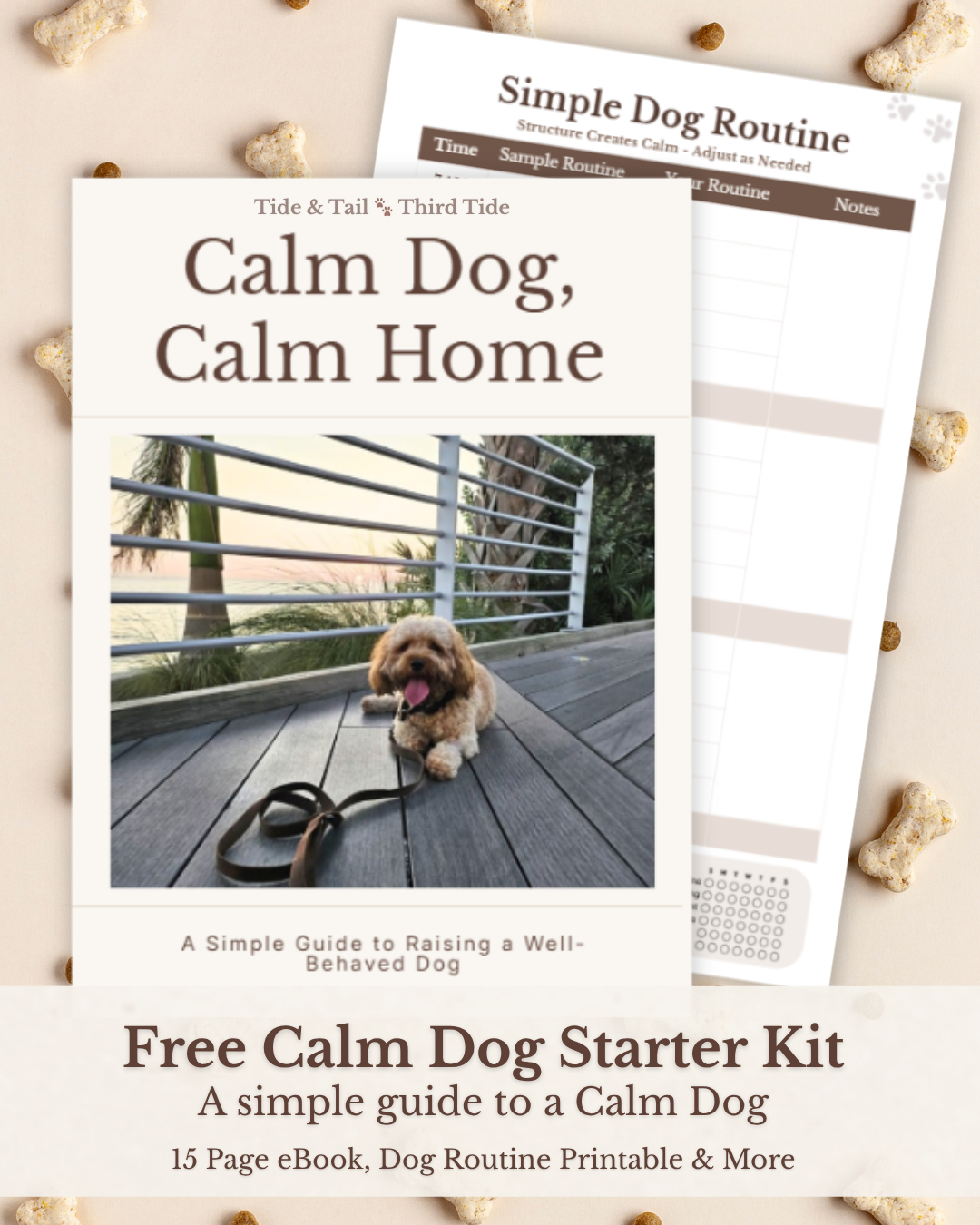
If this is starting to click but you still feel like you want something simple to follow, I put everything I used into a guide you can come back to anytime . It walks through the three-step calm system I used—crate training, teaching place, and consistent clarity—along with a simple routine you can adjust to your own life. Nothing extreme, nothing rigid, just something that helps you stay consistent without overthinking it.
I’ve also included a PDF Page List of training tools from Amazon and products that really helped me shaped my dogs behavior. These items fit into my lifestyle and aesthetic, while still supporting an effective training routine with my new puppy. You’ll find basic dog essentials including kennels, training clickers, baby gates, and more.
Click to shop the Tide & Tail Calm Dog Essentials List
Your dog isn’t going to be perfect every time, and you don’t have to be either. Being perfect is not the goal. The goal is a dog you can actually live with, a home that feels calm, and a routine that works for both of you. That doesn’t come from doing more. It comes from doing a few simple things, over and over again, until it finally clicks. The beauty of it all is that if you stick around, we can make it even easier.